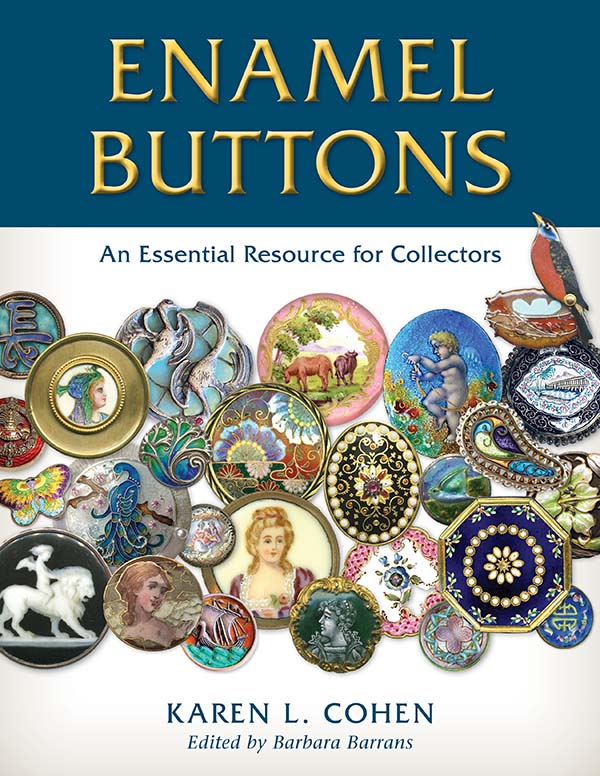

- The book includes much about history of enamel development and how it relates to buttons throughout the centuries. This page will add any information that I find.
Table of Contents
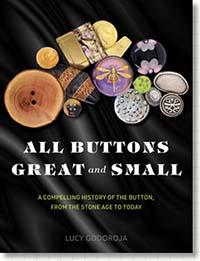
- Book on history of buttons: All Buttons Great and Small
- Battersea
- British Button Society
- Chinoiserie
- Margot Jacoby - buttons from Europe
- Rose Pompadour
|
|
| Page 10 tells of another style of art called Chinoiserie. Here is a Traces of China video that has more information on Chinoiserie. In this video, towards the end, they talk about Cloisonné and then a French ceramic style they call Longwy Cloisonné. This use of the term Cloisonné that is not the usual meaning and could have been included in the sidebar: CLOISONNÉ VERSUS GENERAL ENAMELWARE TERMINOLOGY on page 51. |
|
Started in 1976 with 13 members, this organization has grown to over 200 members in 13 countries. |
|
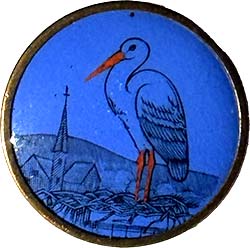
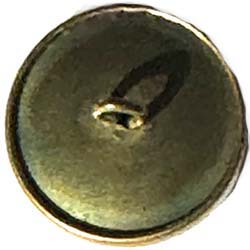
In the 20th century, Margot Jacob, a NYC resident who left Germany during the Hitler regime, was a button dealer who traveled to Europe, often to Paris, France, to buy buttons for sales in the USA. The information in this section was obained from her daugter-in-law, Hanna Jacoby, and Bruce Beck who was friends with Margot. Check two bulletin articles by Margot Jacoby about a collection of 18th Century buttons, mostly porcelain, that she bought at auction in Paris and brought back to the US for sale to collectors: October 1996 bulletin, page 264, titled: 18th Century Buttons, A Unique Collection; December 1996, page 306, titled: An Adventure in Search of Elusive 18th Century Buttons. Margot was mainly interested in Div I buttons, but also brought back vintange buttons from France. There were a set with the same setting - a reverse bezel in gilded brass. Bruce remembers she had gotten about 6 different designs, including a stork and a clock. Here is one (about 15/16") - front and back. I haven't seen these in person, but my guess is that this is either a decal or hand drawn with enamel ink and pen. Bruce said all designs use the same enamel technique.
Margot died at 104, but before then was interviewed for the book Coming of Age: The Story of Our Century by Those Who've Lived It by Studs Terkel (pub. 1995 - pages 430-437). |
|
Battersea is discussed on page 8-9 in my book. In the book: Painted Enamels by Therle and Bernard Hughes, published in 1951, they write about Battersea, on page 60, and the raised scroll work like on the "Battersea Cows" button on the book's cover.. It states: "... it is important to note that none of the proven Battersea work bears any of the raised gilded rococo scrolling so decoratively conspicuous on later enamels. |
|
On page 9 of my book is a sidebar about the color "Rose Pompadour" also called "Rose Du Barry." In the book: Painted Enamels by Therle and Bernard Hughes, published in 1951, they write about this color, on page 83. It states: ... this [color] knows as rose popmadour, originated at Sèvres in 1757 and is not kmown to have been used in England much earlier than 1770. From about 1780, a chrome-tin pink was used in imitation. This was imported by Continental countries under the name of 'English Pink'." |
last updated
07/26/2026